Thoughts On Reading Christian Fiction
- EmmaLee Darr
- Oct 8, 2023
- 3 min read
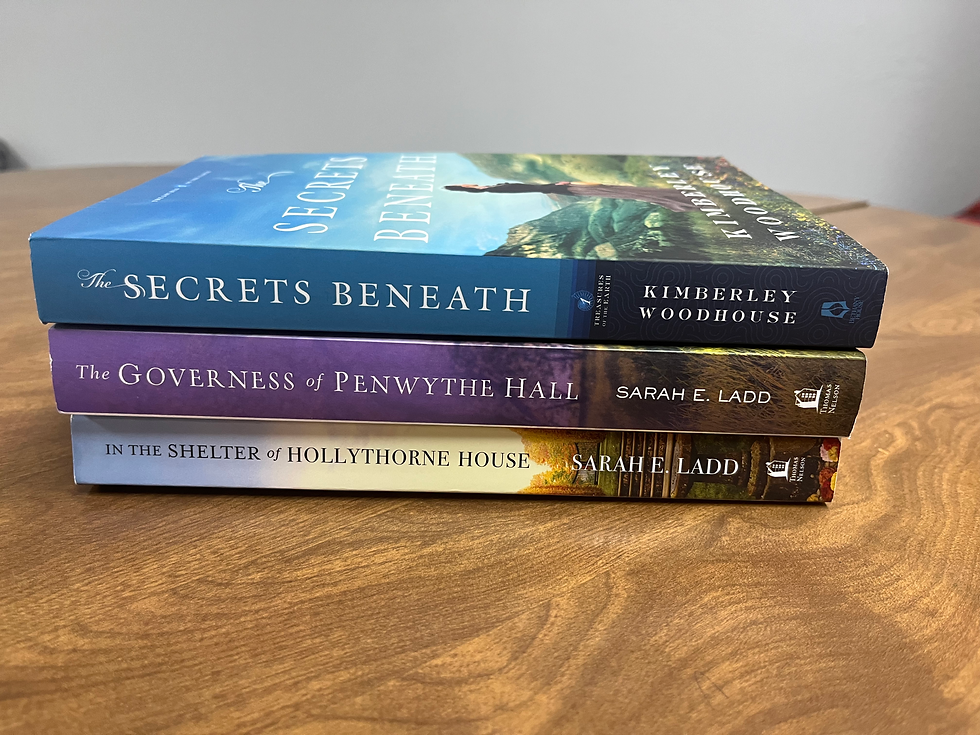
If you follow along with my lists of what I’ve been reading this year, you’ll notice I read quite a few books that fall in the “Christian fiction” category. I’ve heard literally every range of opinion on this from other Christians, everything from we should ONLY read books that are marketed for Christians to anything published as Christian fiction is rubbish and should be avoided. I tend to fall on middle ground with this issue, and today I want to share a few personal thoughts on this matter.
Whether or not a book is marketed as Christian isn’t what determines if it’s actually Christian. That sounds a little backwards, right? But consider for a moment if you meet an individual who claims to be a Christian, yet in the first ten minutes of talking to them they curse every couple words, make crude, sexual comments, and gossip about their friends; you’re going to question their claim to Christianity, right? In addition to this we see clearly in Scripture that even if our outer actions are in line with God’s Word, our hearts can still be far from Him. I get that we are talking about books not people here, yet I think that any good author will tell you that when a book is complete it becomes a sort of living, breathing thing, it becomes alive. So let’s zoom in to the heart of the book, the message behind it. I’ve read many Christian fiction books where there is plenty of “Bible-quoting” yet the heart of it is entirely selfish, focusing on what the characters want instead of God’s will. There are also many, many books in this genre where God and the Bible aren’t mentioned a single time. I’m not saying that all these books are bad, just that I don’t think it’s accurate to call them Christian.
Some of the greatest “Christian” books I’ve read weren’t marketed as such. Building off the last point, I have often found the opposite to be true: if a “Christian fiction” book isn’t necessarily Christian, it stands to reason that secular books may be, in truth, Christian. Les Miserables by Victor Hugo is a perfect example of this; I don’t think there is any better story of redemption, outside of Scripture itself, than this. It shows us clearly how one simple act of forgiveness and grace can point us down a different path, just as Christ’s salvation does for the Christian. Often this takes actually reading the book to be able to determine if it has a Christian message.
Christian fiction can provide a wholesome “escape.” Overall, I don’t think reading should be about escapism; reading should make us want to grow and should stretch us. However, reading should also bring rest. I find that there are two types of rest that can come from reading: the first centers around thought-provoking books that cause us to probe deeper in our lives; this brings an active sort of rest. But there is also a second, equally important, type of rest: the passive kind. I think most of us are looking for this kind of rest when we scroll on our phones: we want a few minutes to “zone out” and put a stop to our spinning thoughts. And this desire isn’t bad in and of itself. The problem comes when we turn to unwholesome avenues for this rest: scrolling social media, binge watching trashy shows, or reading secular rom-coms that are filled with language and intense sexual scenes. These things aren’t filling our minds with what is good, true, and beautiful, and they aren’t going to leave us “rested.” Christian fiction, on the other hand, can provide the chance to read something that is both wholesome and simple. I often find I can look back on my personal reading logs and quickly see what were difficult seasons judging by the number of Christian fiction books I read. Obviously, there are books outside the Christian genre that can also fit these criterial for us, but I find that the seasons where I most need this passive sort of rest are the ones where I don’t want to have to mess with figuring out if a book is going to be clean or not.
There is no right or wrong answer to whether or not we read Christian fiction; each person has to determine for themselves what this is going to look like based on their own convictions and reading interests. Just remember to look at the heart of the book instead of assuming it will fit in a certain category because of the generic label given by a publisher.


Comments